Turn Telegram
into Your Lead Engine
Extract targeted contacts from any Telegram group or channel. Filter by activity, keywords, or AI. Export to CSV, CRM, or Webhook in seconds.
Free plan — no credit card required
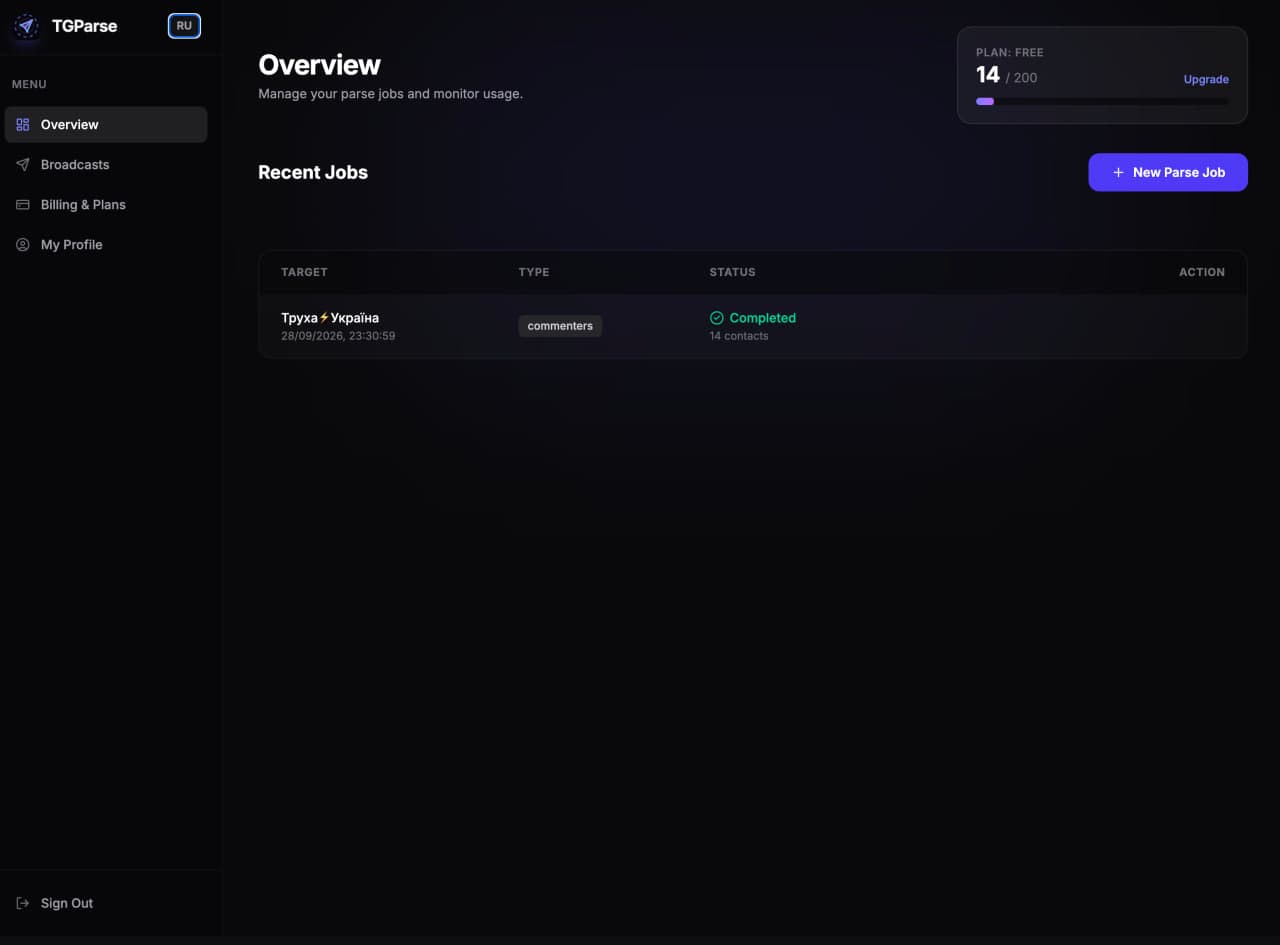
Recent parse jobs
Telegram sources filtered by AI and ready for export.
Built for every growth team
Whether you're a solo founder or a marketing agency, TGParse fits your workflow.
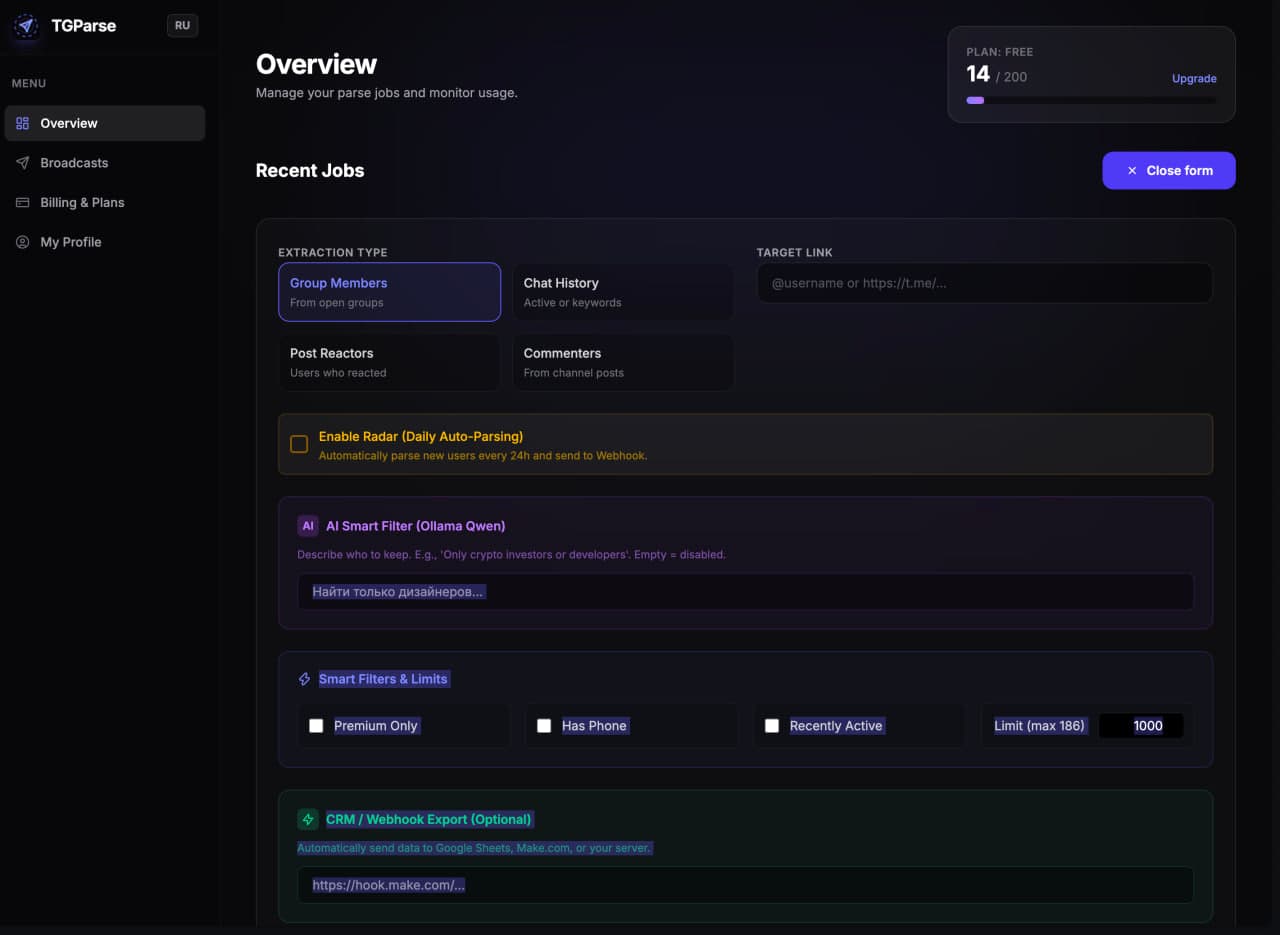
Find customers where they talk
Parse members from competitor groups, niche channels, or any public community. Filter by activity, premium status, or phone availability. Download a clean CSV in minutes.
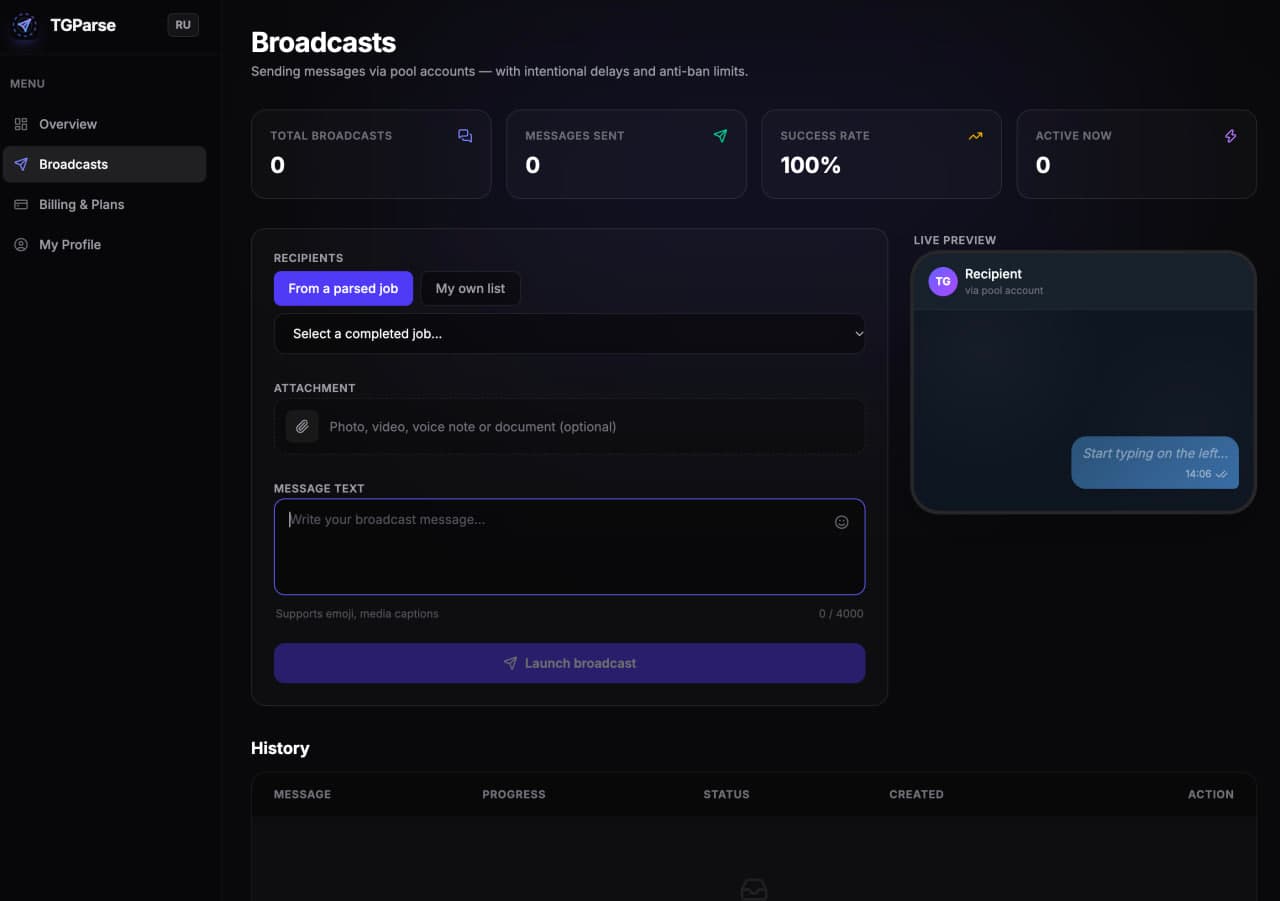
Send campaigns without the ban risk
Built-in pool of warmed-up accounts, randomised delays, and per-account limits. Your campaigns go out — your contacts stay safe.
Pipe leads straight into your stack
Webhook export to Make.com, Zapier, Google Sheets or any REST endpoint. Radar mode auto-parses every 24 h so your CRM is always fresh.
How it works
Paste a link
Group, channel, or post URL — public or invite link.
Set your filters
Activity window, phone number, keywords, AI filter. You decide who makes the cut.
Download & launch
CSV, JSON, or straight to your CRM. Then broadcast right away from the same dashboard.
Everything you need, nothing you don't
4 Extraction Modes
Group Members · Chat History · Post Reactors · Commenters
AI Smart Filter
Describe your ideal lead in plain language. Powered by Ollama Qwen.
Keyword Search
Filter by words in user bios or message history.
Radar Auto-Parse
Set-and-forget: new members parsed every 24 h, sent to your Webhook.
Pool Broadcasts
Send via a fleet of warmed-up accounts with built-in anti-ban delays.
4 Export Formats
CSV · @Usernames · Phone list · JSON. One click.
System or BYO Accounts
Use our pool to keep your profile safe, or connect your own for ultra-cheap parsing.
Cloud-Based
Nothing to install. Works from any device, any OS.
How TGParse solves real work
Two everyday setups, start to finish.
Warm leads from Telegram chats — no manual monitoring
Manually scanning chats for buying intent takes hours, and plain keyword rules can't tell who actually needs your product.
- 1Parse members or messages from the chats you care about
- 2Keyword filter clears out the obviously irrelevant
- 3AI Smart Filter checks intent and keeps only real demand
- 4CSV export includes context, author, source and link
A channel that runs itself: sources → filter → schedule
Keeping a channel active every day means constantly hunting for something worth posting.
- 1Radar mode watches your sources around the clock
- 2New matches are parsed automatically every 24h
- 3Results are pushed straight to your Webhook or CRM
- 4Launch a broadcast to your audience from the same dashboard
Two ways to parse
Use our accounts or connect your own to cut costs.
TGParse Pool
We use our own warmed-up system accounts. Zero setup, zero risk to your Telegram profile. Best for speed and convenience.
- No setup required
- Completely safe
- Instant results
Bring Your Own (BYO)
Connect your own Telegram accounts and proxies. Ultra-cheap fixed pricing for high-volume parsing.
- 10,000 contacts included
- Fixed monthly cost
- Connect via QR code
Trusted by marketers, founders & agencies
"We replaced 3 separate tools with TGParse. Saves us 4+ hours every campaign week."
"Parsed 8,000 leads from competitor groups in under 10 minutes. Conversion on the cold outreach was insane."
"The Radar mode is a game-changer. Our CRM updates itself every morning — zero manual work."